The Symposium of Episcopal Conferences of Africa and Madagascar (SECAM) was born
out of the wish of African Bishops during the Second Vatican Council (1962-1965)
to establish a forum in which they could speak with one voice on matters pertaining
to the Church in Africa. The establishment of SECAM is therefore the result of the
Bishops' resolve to build a continental structure in order to bring forth the African
vision to the whole Church.
Seeing the importance of such an Association for Africa, the Congregation for the
Evangelisation of the Peoples invited the Presidents of the Regional Episcopal Conferences
for consultations in 1968.
Consequently, the first visit of a Pope to Africa, in modern times, was seen as
a very opportune occasion for the launch of the Symposium of Episcopal Conferences
of Africa and Madagascar. This was therefore done during the visit of His Holiness
Pope Paul VI in Kampala (Uganda) in July, 1969.
Thereafter, it was agreed to establish the Headquarters / Secretariat of SECAM in
Accra, Ghana. There are three official languages of SECAM, namely, English,
French and Portuguese.
1962-1965
Vision Born
African Bishops envision SECAM
1968
Consultations Begin
Leader meet to shape
1969
Official Launch
SECAM Inaugurated
Today
Continental Impact
Uniting and

The church in Africa, fully engaged in its mission of evangelization and the emergence of a fully evangelized Family of God in Africa.

To promote the Church's role as a sign and instrument of salvaltion and to build the Church as a family of God in africa by fostering communion, collaboration and joint action among all the Episcopal Conferences of Africa and it's Islands through.
1. Propaganda of Faith
2. Human Development
3. Ecumenism
4. Formation
5. Consultation
1
Primary Evangelization
The continuation of the primary apostolate of first evangelization of those who have not yet received the message of Christ
2
In-depth Evangelization
The in-depth evangelization of the African in his culture and in his socio-political life
3
Integral Human Development
The promotion of integral human development
4
Ecumenism and Dialogue
Ecumenism and inter-religious dialogue in Africa
5
Academic and Pastoral Advancement
The promotion of Institutes of research and of pastoral and theological formation
6
Continental Consultation
Regular consultations on the major problems facing the Church in Africa and in the world
7
Organic Pastoral Solidarity
Promoting The organic pastoral solidarity on the continental Africa and its nearby Islands (Ecclesia in Africa, 5)
As one will observe, most, if not all other Catholic Bishops' Associations use the word
Conference or Council to describe themselves. This, however, is not the case with SECAM
who chose to use the word SYMPOSIUM. The Founding Fathers of SECAM chose the word "Symposium",
because they wanted to emphasize their desire for communion, solidarity, and fellowship.
The word symposium in Greek, signifies meal or banquet. In a speech, the late Cardinal
Paul ZOUNGRANA of Burkina Faso, gave an explanation of the concept of Symposium by using
the image of the Eucharistic table, around which gathers, the community of brothers.
The Core Values of the Symposium
Communion
Solidarity
Fellowship
SECAM, as a Symposium, is an organ of liaison, of study and of consultation for a
fruitful collaboration among the Episcopal Conferences of Africa and Madagascar
through the regional Conferences. It comprises all juridically established Episcopal
Conferences of the entire Africa and Madagascar, grouped under Regional Conferences.
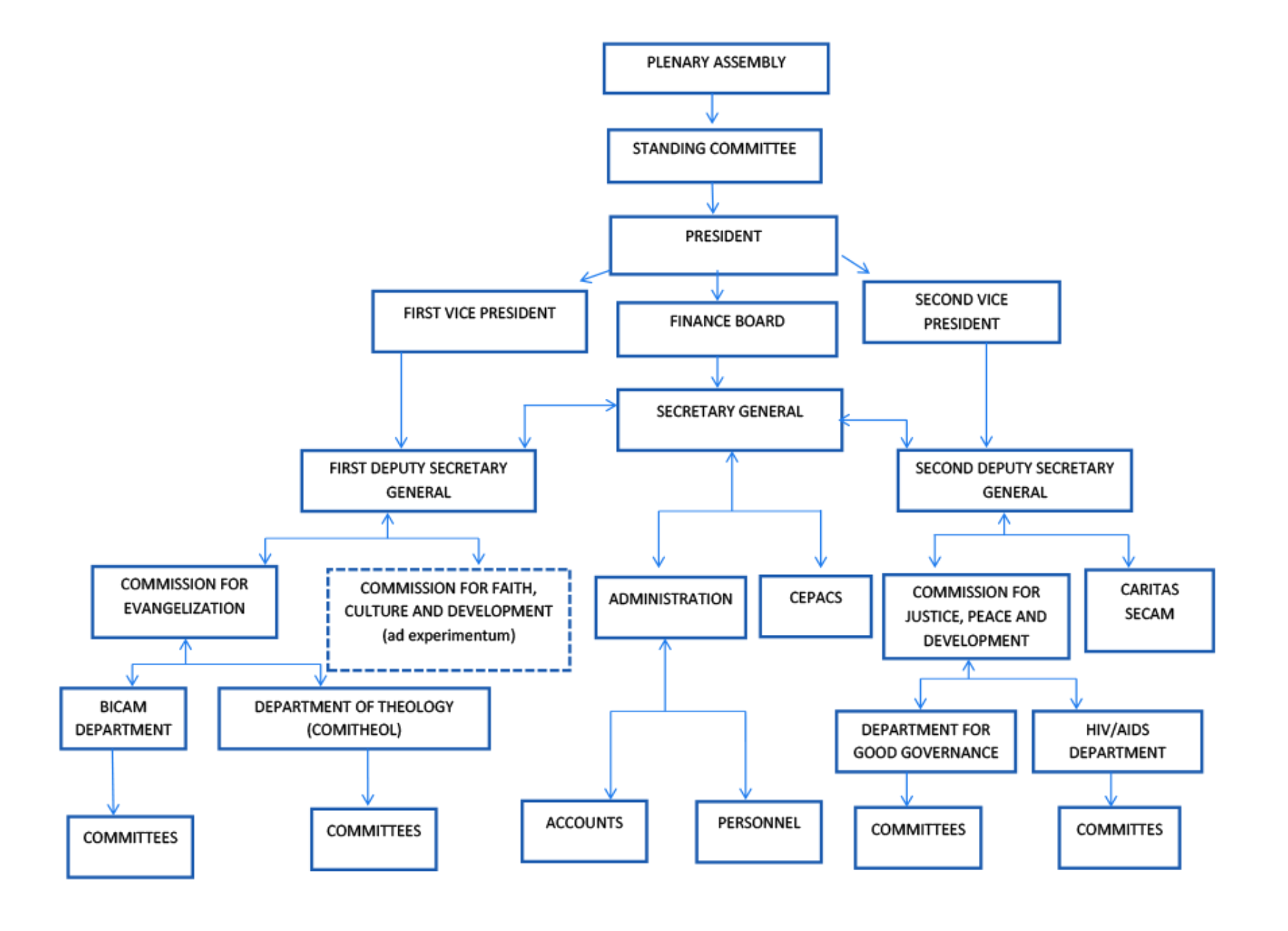
The highest body of SECAM is the Plenary Assembly which unites all members, through
their delegated representatives, once every three years. In between the Plenary
Assemblies, the SECAM Standing Committee runs the affairs of SECAM through its
bi-annual meetings. It is composed of a President and two Vice Presidents,
all elected by the Plenary Assembly. Other members include a Treasurer,
appointed by the Standing Committee, and 8 members, nominated by, and
representing each Regional Conferences. Other members maybe coopted, on an
ex-officio basis, by the Standing Committee.
The Plenary Assembly
The highest body uniting all members via delegate. Meets once every 3 years
The Standing Committee
Managers affairs bi-annually between plenaries
1 President
2 Vice Presidents
1 Treasurer
8 Regional Representatives
Regional Conferences
The foundational groups comprising the entirety of Africa and its Islands

Coordinates and animates the propagation of the Christian faith in Africa and fosters networking among the agents of Evangelization
Addresses doctrinal & moral matters
Pastoral care from an African perspective
Grounded in divine revelation

Responsible for issues pertaining to social justice, integral human development, and broader socio-economic challenges
Promotes integral human development
Addresses political & cultural
Guided by Church social doctrine
Association of Episcopal Conferences of Central Africa (ACEAC)
Association of Episcopal Conferences of Central Africa Region (ACERAC)
Regional Episcopal Conferences of West Africa (RECOWA/CERAO)
Association of Member Episcopal Conferences of Eastern Africa (AMECEA)
Regional Episcopal Conferences of North Africa (CERNA)
Inter-Regional Meeting of the Bishops of Southern Africa (IMBISA)
Assembly of the Catholic Hierarchy of Egypt (AHCE)
Madagascar and Episcopal Conferences of Indian Ocean (CEDOI)
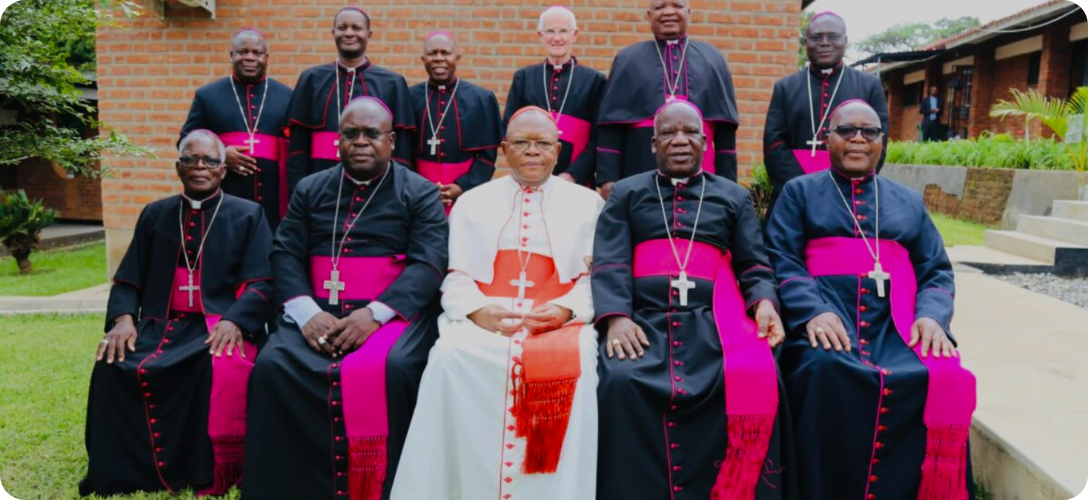
STANDING COMMITTEE

H. Em. Fridolin Cardinal AMBONGO BESUNGU, OFM Cap
Archbishop of Kinshasa, DRC
President
Most Rev. Stephen Dami MAMZA
Bishop of Yola, Nigeria
1st Vice-President
Most Rev. José Manuel IMBAMBA
Archbishop of Saurimo, Angola
2nd Vice-President
Most Rev. Gabriel Edoe KUMORDJI, SVD
Bishop of Keta-Akatsi, Ghana
Treasurer
Most Rev. José MOKO EKANGA
Bishop of Idiofa, DR Congo
ACEAC Representative
Most Rev. Martin WAÏNGUE BANI
Bishop of Doba, Chad
ACERAC Representative
Most Rev. Claudio LURATI, M.C.C.I.
Apostolic Vicar of Alexandria, Egypt
AHCE Representative
Most Rev. Anthony MUHERIA
Archbishop of Nyeri, Kenya
AMECEA Representative
Most Rev. Benjamin Marc RAMAROSON, C.M.
Archbishop of Antsiranana, Madagascar
CEDOI Representative
John MACWILLIAM
Bishop of Laghouat-Ghardaïa, Algeria
CERNA Representative
Most Rev. Willem CHRISTIAANS, O.S.F.S.
Bishop of Keetmanshoop, Namibia
IMBISA Representative
Most Rev. Joseph AFRIFAH-AGYEKUM
Bishop of Koforidua, Ghana
RECOWA Representative
Msgr. Pierre CIBAMBO
Caritas Africa President
Most Rev. Bernardin Francis MFUMBUSA
Bishop of Kondoa Diocese, Tanzania
CEPACS President


Rev. Fr. Rafael Simbine Junior
Secretary General
Rev. Fr. Zephirin Moube
1st Deputy Secretary General
Rev. Fr. Uchechukwu Obodoechina
2nd Deputy Secretary General
Rev. Fr. Anselm Kamuyu
BICAM Director
Rev. Fr. Edouard ADE
In Charge of Faith, Culture & Dev. Commission
Fr. Dr. Louison Emerick Bissila Mbila
SECAM Liason Officer at the African Union
Mrs. Mavis Anima Bonsu
Head of Finance and Administration of SECAM
Mr. Charles Ayetan
Communication Officer
Mr. Joseph Kofi Asuako
Programme Officer of SECAM-JPDC
Sr. Consolata Aloo, FSSA
Secretary at SECAM-AU Liaison Office
Mrs. Juliana Zukpar
Cook
Mr. Anicert Alipoe
Driver
Mrs. Lydia Benzie
Office Assistant
Mr. Felix Naalane
House Keeper
Mr. George Saatuur
Gardener
STAFF